Case Study
Helping a PCV Vaccine Manufacturer Achieve Efficient & Sterile Separation
Nanjing BioPAS Pharma Equipment Tech Co.– Driving Biopharmaceutical Process Upgrades with Innovative Technology
In the high-end biopharmaceutical equipment sector, Nanjing BioPAS has been committed to delivering solutions that meet our clients’ evolving needs.
Our disc centrifuges not only meet GMP sterile requirements but also feature CIP, SIP, fully enclosed, and continuous production capabilities, and have been successfully applied in vaccines, antibodies, insulin purification, and other bioprocesses.
Customer Challenge
In March 2025, a leading domestic Porcine Circovirus (PCV) vaccine manufacturer approached us.
They used PK15 cells combined with microcarriers in suspension culture to produce PCV vaccines, maintaining a strong market share.
However, in the virus harvesting and separation stage, their traditional freeze-thaw sedimentation and tubular centrifuge process faced multiple problems:
- Non-closed process, posing contamination risks
- Freeze-thaw required large cold storage space and long processing time
- Tubular centrifuge had low efficiency and could not process continuously
- High manual labor cost
They urgently needed a continuous-feed, fully sterile solution that could achieve a supernatant turbidity equal to or better than the tubular centrifuge (700–1000 NTU before separation → ≤200 NTU after separation) and protein recovery ≥80%.
Our Solution
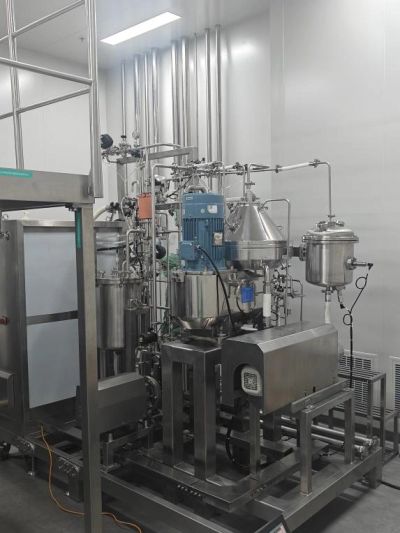
After technical evaluation, we recommended the BPS-L305 disc centrifuge (8500 rpm, separation factor 12,000 G) with full SIP capability and a sterile, enclosed design.
This configuration ensures stable, high-efficiency, continuous separation.
Customer Feedback
The customer was very satisfied with the results, confirming that the BPS-L305 fully met their needs for high efficiency, sterility, and continuous production.
The solution not only reduced labor costs but also significantly improved separation efficiency and production stability.

Case Study
Enabling Efficient Enzyme Extraction with BPS Disc Centrifuge
Nanjing BPS – Delivering Smarter Separation Solutions for Biopharma
Customer Challenge
In July 2025, a professional manufacturer of lumbrokinase raw materials approached us.
Since 1998, this company has supplied lumbrokinase-based health products nationwide and provided raw materials to pharmaceutical enterprises. With a new factory under construction and scheduled for production by the end of 2025, their demand for higher capacity and automation was urgent.
In their legacy process, earthworm homogenate was first separated by a decanter centrifuge, and then the supernatant was further clarified using multiple tubular centrifuges. This approach created several bottlenecks:
- Tubular centrifuges had limited throughput, requiring multiple units in parallel
- Dozens of workers were needed for operation and maintenance
- The process was labor-intensive, time-consuming, and inefficient
- Continuous feeding was not possible, leading to high costs
The company sought a solution that could achieve the same or better separation performance as tubular centrifuges, with fully automated CIP, continuous feeding, and stable temperature control.
Our Solution
We proposed the BPS-L204-C disc centrifuge (11,000 rpm, separation factor 14,000 G), equipped with an automatic CIP system. The system design ensured:
- Continuous feeding with consistent separation quality
- Automated CIP cleaning, reducing manual labor
- Efficient cooling via jacketed design to keep temperature rise within 5°C
High product recovery (enzyme activity yield ≥93%)
Performance Highlights
The customer prepared 1000 L of raw material for pilot testing. With the BPS-L204-C:
- The entire batch was processed in 80 minutes (vs. 3 hours with tubular centrifuges)
- Post-separation, the supernatant had an average solid content of only 0.47%
- Discharge cycles were fully automated, with flexible intervals and durations
- Temperature rise was consistently controlled below 5°C
Operators noted that instead of manual intervention, they could now simply monitor the process on a screen—while enjoying a cup of tea.
Customer Feedback
The customer confirmed that all test results met or exceeded their expectations. They were especially impressed with the significant improvements in:
- Processing efficiency (80 minutes vs. 3 hours)
- Labor savings (fully automated operation, minimal workforce required)
- Product quality (high enzyme activity maintained, reliable solid removal)
They expressed strong satisfaction with the BPS-L204-C, recognizing it as a future-ready solution for their upcoming large-scale production.

Case Study
Disc Centrifuge Separates Pichia pastoris Fermentation Broth Efficiently
Nanjing BPS – Pioneering Custom Separation Technology for Emerging Industries
Customer Background & Challenge
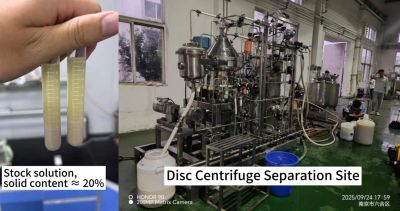
On September 24, 2025, we completed an on-site trial in Nanjing for a client requiring separation of Pichia pastoris fermentation broth, which carried a high solid load of approximately 20%. The client required a stable, continuous separation process to extract crystal-clear supernatant from the high-solids broth while fully recovering yeast biomass. Traditional separation equipment struggled to balance high clarification and continuous operation, creating a major bottleneck in their production line.
Our Solution
We deployed a full disc centrifuge unit for on-site continuous separation trials, following this test workflow:
- Feeding: Raw fermentation broth with 20% solid content was directly fed into the disc separator;
- Continuous operation: The machine ran uninterrupted, automatically diverting concentrated biomass sludge and clarified supernatant into separate collection vessels;
- Effect validation: The collected supernatant was re-tested on a bench centrifuge to quantify clarity and separation efficiency.
Test Results & Customer Feedback
- Reliable solid-liquid splitting: The disc separator completed phase separation stably, outputting thick concentrated yeast sediment and transparent supernatant simultaneously.
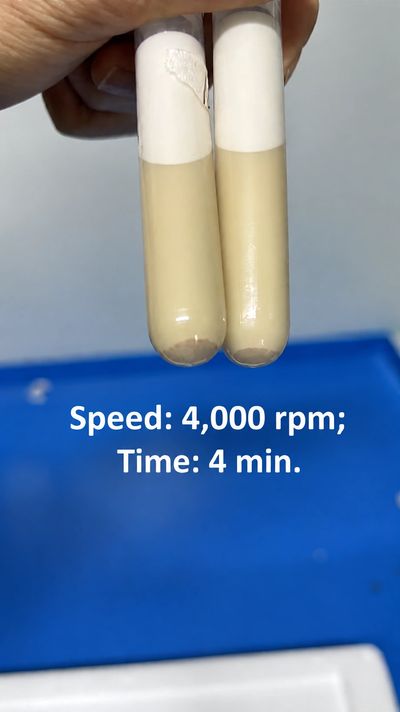
- High separation precision verified: After re-centrifuging the disc centrifuge effluent on lab equipment, no visible sediment remained in the liquid, confirming exceptional separation precision.
- Client evaluation: The unit maintained steady continuous operation and completely resolved the separation challenge posed by 20% high-solids yeast broth. The resulting clear supernatant is directly compatible with downstream purification steps, eliminating the client’s original process bottleneck.
Case Study
Disc Centrifuge Boosts Efficiency for Biobased Material Manufacturer
Nanjing BPS – Driving Innovation in Separation Technology for Emerging Industries
Customer Background & Challenge
In March 2025, a biobased material company in Shaanxi, co-developing with Jiangsu XX University, approached us for help.
Their core project was to extract bisabolol (α-Bisabolol) from fermentation broth, which contained solids, a large amount of water, and a small amount of oil.
Initially, the company relied on distillation for separation. Although the yield was relatively high, the method had serious drawbacks:
- Extremely slow process, long cycles, labor-intensive
- Unsuitable for pilot scale or large-scale industrial production
- Unable to meet their expanding capacity needs
The company urgently needed a continuous-feed disc centrifuge with automated CIP, capable of achieving separation efficiency close to distillation, while keeping bisabolol levels in the light, heavy, and solid phases within specification.
Our Solution
We recommended the BPS-L608SJ disc centrifuge (9,000 rpm, separation factor 14,000 G), designed for three-phase separation and equipped with full CIP cleaning capability.
During testing, we discovered that the customer’s material had an unconventional phase ratio: unlike typical three-phase feedstocks (more light phase, less heavy phase), this broth showed the opposite.
As a result, the standard gravity ring configuration did not deliver the expected results. After multiple trials and fine-tuning of the gravity ring, our team identified the optimal setup tailored to this material.
Test Results & Customer Feedback
- Initial trials compared bench centrifugation, traditional three-phase centrifuges, and our new external ring discharge machine; the customer favored our proposed solution.
- Separated materials were sent back to the customer for verification using gas chromatography (GC), and the results fully matched expectations.
- By late May 2025, the customer signed a purchase agreement with us. The equipment was delivered in August and successfully accepted after testing.
- All performance data verified by GC confirmed compliance with process requirements.
The customer reported that the BPS-L608SJ delivered stable separation, easy operation, and efficient cleaning, fully resolving their process challenges. With production capacity expanding, they are planning to purchase additional units of the same model.

Case Study
Efficient Separation Challenge: E. coli Broth Lysate
Nanjing BPS – Driving Innovation in Separation Technology for Emerging Industries
Customer Background & Challenge
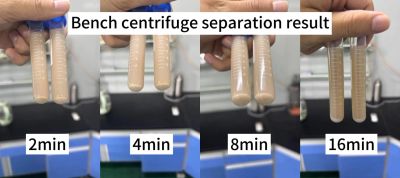
A Shandong biotech client faced severe separation difficulties with their E. coli fermentation lysate, characterized by low solid content and extremely poor settling performance. The feedstock only contained around 2.5% solids, and extending centrifugation duration barely improved clarification. Even when the supernatant from primary centrifugation was re-centrifuged, roughly 1.5% sediment still formed, fully proving the material’s poor settleability. The lysate is filled with ultrafine particles that resist sedimentation. Standard lab centrifuges failed to deliver the required liquid clarity, and competing centrifuges could not match our separation performance even after two full separation cycles.
Our Solution
We recommended the BPS-L305 Disc Separator to address the client’s tough working condition: E. coli lysate with 2.5% solids and hard-to-settle micro-fine particles.
Preliminary lab centrifuge tests validated the material’s separation difficulty: after 16 minutes of bench centrifugation, solid concentration remained nearly unchanged, and secondary centrifugation of the supernatant still left 1.5% residual solids. Conventional equipment was therefore unfit to produce crystal-clear effluent, making our disc centrifuge the optimal solution.
Test Results & Customer Feedback
Single-pass processing with our disc centrifuge yielded perfectly clear supernatant that fully met the client’s quality standards. Verification tests were conducted on supernatant collected after 7-minute and 27-minute disc centrifugation runs: re-spinning both samples on a bench centrifuge produced virtually no sediment at the bottom of tubes, delivering far superior clarity compared to competitors’ two-stage separation workflows. When asked about the source of our superior separation performance, we explained our core technical edge: every stage, from mechanical design and precision component machining to full machine assembly, is refined with meticulous attention to detail, enabling the outstanding overall separation efficiency seen in testing.

Case Study
BPS Disc Centrifuge Enables Efficient Microsphere Washing and Separation
Nanjing BPS – Pioneering Custom Separation Technology for Emerging Industries
Customer Background & Challenge
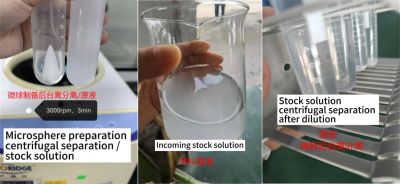
In October 2025, a Nanjing pharmaceutical R&D firm developing polylactic acid drug-loaded microspheres for embolization therapy approached us to optimize their separation workflow, which suffered from multiple critical drawbacks: Unique material challenges: The self-developed polymer microspheres become sticky after agitation, creating high clogging risks for separation equipment. The aqueous suspension contains residual surfactants from synthesis, which readily generate heavy foam and further complicate separation. Process target: Fully remove residual surfactants to meet injectable pharmaceutical purity criteria. Limitations of existing process: The client previously used a tubular centrifuge, which required five repeated washing cycles to barely hit purity standards. Worse, tubular centrifuges cannot run continuously, resulting in overly labor-intensive, material-wasteful workflows. The client sought a disc centrifuge as a more efficient alternative.
Our Solution
We selected the BPS Disc Centrifuge for full washing and separation trials, with the following material preparation and core test parameters:
Material pre-treatment: The original 100L microsphere suspension measured 1–2% solids after lab centrifugation. Prior to feeding the disc separator, the client further diluted the stock solution, bringing inlet solid content down to 0.3%.
Feed flow rate: A steady feed rate of ~100 L/h was maintained; higher flow rates were not tested due to limited material supply.
Discharge cycle optimization: An initial 5-minute sludge discharge interval was used to assess clogging risk. Observation confirmed the concentrated microsphere sludge had excellent fluidity with minimal blockage risk, so we extended the discharge cycle to 15 minutes to boost solid-phase concentration.
Test Results & Customer Feedback
· Sludge concentration performance: Each discharge (5-min or 15-min cycle) produced around 2L of microsphere sludge, matching the design expectations of BPS Disc Centrifuge. Sludge collected under the 15-minute cycle was far more concentrated than that from 5-minute intervals. A total of 7.1L concentrated microsphere sludge was recovered over the full trial, meeting the client’s concentration targets. With sufficient raw material supply, longer discharge intervals could be tested to achieve even higher solid density.
· Continuous cyclic workflow capability: The disc separator supports uninterrupted feeding and enables closed-loop cyclic processing: sludge collection → dilution → washing → re-separation.
· Complete microsphere protection: Post-trial microscopic analysis by the client confirmed intact microsphere morphology under both 5-minute and 15-minute discharge schedules, with no breakage or deformation of microspheres.
· Client feedback: The BPS Disc Centrifuge delivered far superior washing and separation results compared to their original five-cycle tubular centrifuge workflow. The solution drastically cuts labor and raw material consumption, shortens R&D scale-up timelines, and delivers significant cost savings. Its continuous processing capability streamlines the entire microsphere washing and purification sequence.